
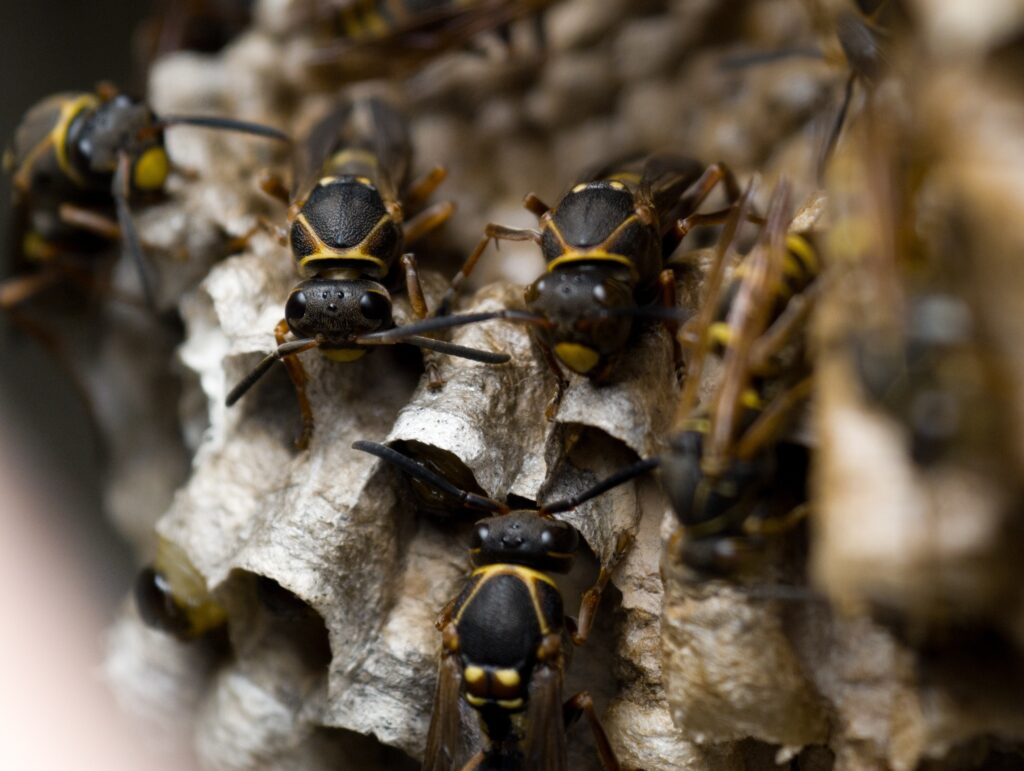
Wasps in Virginia can create costly problems when early signs are missed. Learn what to look for, why it matters, and when to call Proforce.
Key Takeaways About Wasp Types in Virginia
- Virginia homeowners may encounter several wasp types, including paper wasps, yellowjackets, and hornets, each with distinct body shapes, colors, and nesting habits that help with identification.
- Some wasps nest in the ground while others build exposed or sheltered aerial nests, so knowing where to look can help you spot activity early.
- Certain species can sting more than once, and some are more defensive around their nests or food sources than others.
- Correct identification matters because look-alike species vary in behavior, and Proforce service professionals use species-specific treatment methods to address each type.
How to Identify Wasp Types in Virginia
Telling one wasp species from another starts with a few quick visual checks and a look at where the nest is located. Virginia homeowners may encounter several species around the yard, and knowing the differences helps you decide what you are dealing with.
How to Tell Wasp Types Apart in Virginia
Most wasp problems in Virginia come down to a few species, separated by body shape, color, and where they nest. The table below is the fastest way to narrow down what you’re looking at. Match what you’ve seen on size, color, and nest location, then check the last column to decide how urgent the call is.
| Species | Size | Color | Where to look | Risk | Sting |
|---|---|---|---|---|---|
| European hornet | 3/4–1 3/8″ | Brown with yellow abdominal bands, reddish head | Protected aerial spots: hollow trees, wall voids, attics | Active at night; multiple painful stings per encounter | Yes |
| Bald-faced hornet | 5/8–3/4″ | Black body with white face and white abdominal markings | Large gray paper nests hanging from tree branches, eaves, or shrubs | Highly defensive near the nest; multiple stings per encounter | Yes |
| Yellowjacket | 3/8–5/8″ | Bright yellow and black bands | Underground nests in lawns, garden beds, and old rodent burrows | Aggressive in late summer and fall; mowing or yard work can trigger swarming stings | Yes |
| Paper wasp | 5/8–3/4″ | Reddish brown to dark brown, narrow waist | Open umbrella-shaped combs under eaves, porch ceilings, and grills | Stings when nest is disturbed; less defensive than yellowjackets | Yes |
| Guinea wasp | 1/2–5/8″ | Yellow and brown markings, slimmer than a yellowjacket | Protected spots around buildings, equipment, and dense shrubbery | Defends nest with stings; often misidentified as a yellowjacket | Yes |
If what you’re seeing doesn’t match any row cleanly, that’s a sign the nest may be tucked in a wall void or you’re looking at a less common look-alike. A pro can confirm before treatment.
Yellowjackets have distinct yellow and black markings and tend to be more aggressive than other species. Paper wasps, by contrast, have narrow waists and are generally less aggressive. According to Oregon State University Solve Pest Problems, these two groups are common look-alikes, so body shape is one of the fastest ways to separate them.
Guinea wasps add another layer of confusion. According to Mississippi State University Extension, guinea wasps are often mistaken for yellowjackets, but yellowjackets are yellow and black and build their nests in the ground. Checking both color pattern and nest location can help you sort out which species is present.
Some species are solitary rather than social. Solitary wasps lay eggs in individual nests that are not tended by other individuals, unlike communal paper wasps or social bees.
How to Spot Wasp Activity Inside Your Virginia Home
Wasps that nest near your home may occasionally find their way indoors. You might notice a single wasp circling a window or light fixture. Social wasps sting to defend their colony, so a wasp inside the house is typically disoriented rather than attacking. Avoid swatting, and watch for a pattern that suggests a nest is nearby.
Where Wasp Activity Shows Up Around Virginia Homes
Most species are relatively unaggressive, but they can become a problem when they nest over doorways or in other areas of human activity such as fruit trees. Yellowjackets build their nests in the ground, so you may spot traffic at a small hole in the lawn or garden bed. Paper wasp nests often hang from eaves or porch ceilings.
Some yellow jacket species can become aggressive during late summer and fall and may sting unprovoked, according to the University of Minnesota Extension. Paying attention to nest locations during warmer months helps you stay ahead of that shift.
Exterior Entry Points Wasps Use Around Virginia Homes
Wasps look for sheltered spots to establish a nest. Gaps under soffits, openings around roof lines, and spaces behind shutters can all attract nest-building activity. If a nest needs to be addressed, it is easiest to do so in the evening when the wasps are inactive.
Some species are more aggressive than others and may fly several feet to sting someone who happens to be near the nest site. Keeping your distance and noting the exact location of the nest gives your Proforce service professional the information needed for a species-specific approach.
Why Wasp Problems Develop in Virginia
Wasp problems around Virginia homes usually start when nesting sites, food, and shelter overlap with everyday outdoor living spaces. Understanding what draws wasps in and how they move around your property can help you recognize activity early and decide on next steps.
Outdoor Nesting Areas for Wasps Around Virginia Homes
Different wasp species choose different nesting spots. Yellowjackets typically nest underground, while bald-faced hornets build large exposed nests in trees. European hornets select protected aerial locations for their paper nests. According to Penn State Extension, these preferences mean you may find nests in very different parts of your yard depending on the species present.
Paper wasp nests and European hornet colonies last only one season. Colonies perish with autumn frosts, and only fertilized queens survive through winter. Those overwintering queens shelter in protected locations such as fallen tree bark crevices or building wall voids until the following spring.
Food and Shelter That Attract Wasps Around Virginia Homes
Yellowjackets prey on other insects and scavenge on human food and garbage. That dual diet is one reason they show persistent, pugnacious behavior around food sources. Leaving food or garbage uncovered outdoors can draw yellowjackets closer to patios, decks, and doorways.
Most social wasps also provide a beneficial service by preying on large numbers of other pest insects. When they nest away from high-traffic areas, they can be helpful. Problems develop when nesting and food-scavenging overlap with spots where your family spends time.
How Wasps Move Around Virginia Homes
Social wasp colonies include individuals whose task is to defend the nest. As colonies grow through the warmer months, more defenders patrol the area around the nest. Removing food sources can reduce the number of wasps foraging near your home, according to UC IPM.
Yellowjacket queens overwinter alone, while paper wasp queens overwinter in groups. If you see wasps indoors during cooler months, they are not coming from an active nest but from a sheltered overwintering spot within your home’s structure.
Trails and Entry Points Wasps Use in Virginia
Wall voids and bark crevices serve as common overwintering shelters for queens. European hornet queens, for example, seek out these protected spaces as temperatures drop. Come spring, surviving queens leave their overwintering shelters and begin building new nests nearby.
Because every nest is annual, new colonies can appear in different locations each year. Watching for early nest-building activity around your home’s exterior helps you stay ahead of wasp problems before colonies reach full size.
Risks From Virginia Wasps
Wasps belong to the order Hymenoptera, a group of stinging insects that also includes bees and ants. According to UC IPM, stinging insects are limited to this order. For Virginia homeowners, understanding the risks these pests pose helps you decide when a nest needs attention and when it can be left alone.
Health Risks Linked to Virginia Wasps
The primary concern with wasps is the sting itself. Most people think of wasps as harmful pests because of their stings, though some species, like paper wasps, can also be beneficial. A sting from a wasp near a doorway or high-traffic area of your yard is more likely because of proximity.
Paper wasp nests built in the wrong place, where they are likely to cause stings, need to be addressed before the colony grows. Nests tucked under eaves or along walkways put your household at greater risk of an unexpected encounter with stinging insects.
Property Damage From Wasps in Virginia
Wasps are primarily a sting risk rather than a structural pest. Their nests, however, can become a nuisance when attached to your home’s exterior. Removing a nest early, before the colony grows, is generally easier and reduces the chance of repeated stings during the process.
Food Areas and Wasp Activity in Virginia Homes
Outdoor dining areas, patios, and grills can draw wasps closer to your living space. When stinging insects gather near food, the likelihood of a sting increases. Keeping these areas tidy and watching for nearby nest activity can help you spot a developing problem before it puts your family at risk.
When to Look Closer at Wasp Activity in Virginia
Not every wasp nest requires removal. As Mississippi State University Extension notes, although most people think of wasps as harmful insects because of their stings, paper wasps are also beneficial. The key is location. A nest in an out-of-the-way corner of your yard may pose little risk, while one near a door, porch, or play area deserves a closer look.
If you notice wasps flying a consistent path to and from a spot on your home, that pattern often points to a nest. Tracking where stinging insects enter and exit gives you a head start on deciding next steps.
Professional Pest Control for Wasps in Virginia
Knowing which wasp you are looking at helps determine the right response. Some species build nests in protected areas around buildings or dense shrubbery, while others nest in spots that rarely overlap with foot traffic. Proper identification guides whether treatment is needed at all, and a trained eye can tell the difference between a wasp and a less aggressive look-alike such as a honey bee or bumble bee.
How to Reduce Attractants for Wasps in Virginia
Wasps tend to nest in sheltered locations close to structures. According to Mississippi State University Extension, guinea wasps (Polistes exclamans) build their nests in protected areas around buildings, equipment, and dense shrubbery. Trimming overgrown landscaping and keeping storage areas tidy can make those spots less inviting.
Paper wasp nests do not always require treatment. As UC IPM notes, these nests should not need attention unless they are near people. Keeping outdoor dining areas and high-traffic walkways clear of overhanging vegetation reduces the chance that a nest ends up in a problem spot.
Why Wasp Control in Virginia Starts With Inspection
Before any treatment decision, a thorough exterior inspection matters. Proforce service professionals observe surroundings and note hazardous landscaping features, then identify the species and nest location. This step is important because wasps are quick to defend a disturbed nest by stinging.
Identification also prevents unnecessary treatment of look-alikes. Honey bees, bumble bees, and bald-faced hornets can resemble certain wasp species but may call for a different approach. Accurate species confirmation helps the service professional choose the right next step.
What to Expect During Professional Wasp Treatment in Virginia
Proforce applies species-specific treatment methods after confirming the wasp type and nest location. Options include dusting, drenching, void treatments, and aerosol applications. Treatments are often performed early morning, evening, or dusk, when wasps are less active around the nest.
Service professionals wear proper protective equipment, including bee suits, during treatment. Once the nest is no longer active, it is removed when possible, sealed in a plastic bag, and disposed of at the branch office. Interior service is not included as a standard part of the process.
What to Expect From a Virginia Wasp Control Plan
A licensed pest control professional can assess whether a nest on your property requires treatment or can be left alone. As UC IPM recommends, locating a licensed pest control operator is the appropriate step when a nest needs attention.
Proforce covers wasps and yellow jackets under its general pest control plan. The service does not prevent future nests from forming, so if new activity appears later, you should reach out for follow-up treatment. Each visit includes a fresh exterior inspection and species-specific approach based on what the service professional finds.
Bottom Line on Wasp Types in Virginia
Knowing what you are looking at is the first step toward handling any wasp situation around your home. Color patterns, body shape, nest style, and behavior all help separate one species from another. Some wasps nest in the ground, others build paper or mud structures under eaves and ceilings, and their defensive tendencies vary just as much. When you spot a nest on or near your home, reach out to Proforce Pest Control for a professional assessment so the right approach is used from the start.
How Can I Tell Which Wasp I Am Looking At?
Pay attention to body shape, color, and where the nest is located. Some species are yellow and black while others are brown and yellow. Thread-waisted wasps tend to be solitary, and stouter wasps are more likely to be social nest builders. Nest placement, whether underground, in dense shrubbery, or attached to a wall, is another strong clue.
Are All Wasps in Virginia Aggressive?
No. Aggression levels differ by species. Some wasps may fly several feet to sting someone near the nest, while others are not particularly aggressive and sting only when provoked. Solitary species attended by a single female are generally less defensive than large social colonies.
Do Wasp Nests Come Back Every Year?
Paper wasp nests last only one season. However, the same sheltered spot can attract new nest-building activity the following year. Removing old nests and monitoring protected areas around your home can help you stay ahead of new activity.
Should I Remove a Wasp Nest Myself?
Approaching a nest without proper protection carries a real sting risk, especially with more defensive species. Proforce service professionals wear protective gear and use species-specific treatment methods, including dusting, drenching, and aerosol applications, often performed during early morning or evening hours when wasps are less active. Once the nest is cleared, it is removed and disposed of properly.