
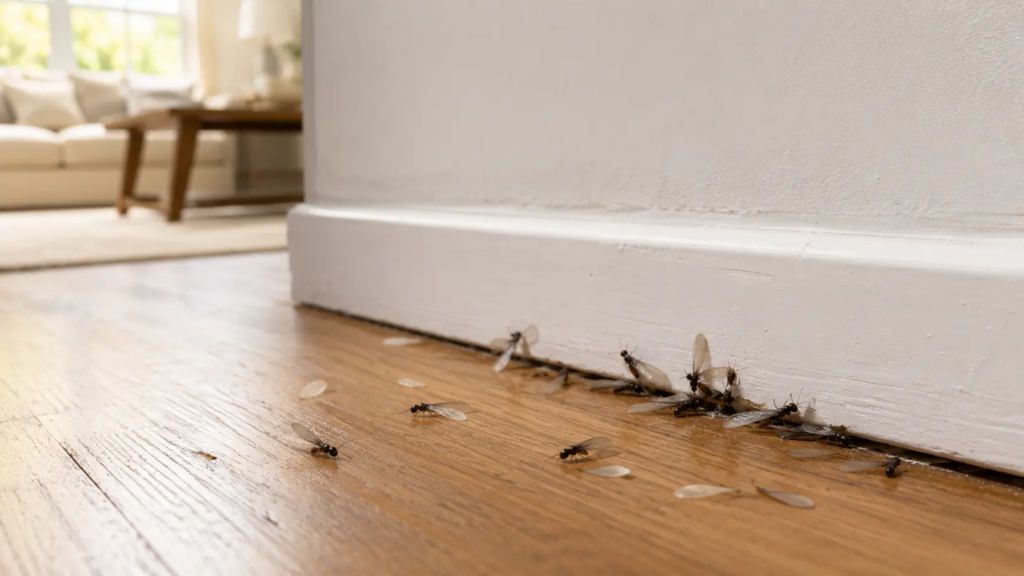
| QUICK ANSWER: WHAT TO DO WHEN TERMITES SWARM INDOORS Stay calm and do not reach for the bug spray. Swarmers cannot bite, sting, or damage wood, and spraying them only destroys the evidence a professional needs while doing nothing to the colony that produced them. Instead, close the door to the room, collect a few swarmers or shed wings in a sealed jar or bag, note exactly where they emerged, and schedule a professional inspection. Swarmers emerging indoors usually means a mature colony is already established in or against your home. |
Few things get a homeowner’s heart rate up faster than a cloud of winged insects pouring out of a baseboard. The instinct is to grab whatever spray is under the sink and go to war. Resist it. The swarmers you can see are the least dangerous termites in your house. It is the colony you cannot see that matters, and how you handle the next hour affects how quickly a professional can find it.
First, Understand What You’re Looking At
Swarmers (the technical term is alates) are the winged reproductive termites a colony releases to start new colonies. They do not eat wood, and most of them die within a day of emerging. The swarm itself is not the threat.
The swarm is the message. Subterranean termite colonies typically do not produce swarmers until they are several years old and well established. When those swarmers emerge inside your home rather than out in the yard, it strongly suggests the colony is living in or directly against the structure. That is worth taking seriously, but it is not an emergency measured in minutes. Termite damage accumulates over months and years, so you have time to do this right.
The 4-Step Response
- Contain the room. Close interior doors and, if the swarm is heavy, switch off the HVAC vents in that room so swarmers are not carried through the house. Swarmers are drawn to light, so they will cluster at windows and fixtures, which makes the next step easier.
- Collect a specimen. Save several swarmers or shed wings in a sealed jar or zip-top bag. Species identification changes the treatment plan, and it also confirms you are dealing with termites rather than flying ants, which swarm around the same time of year.
- Map the exit point. Note or photograph exactly where they emerged: the specific baseboard, drywall crack, window casing, or floor gap. Swarmers exit close to the colony or its mud tubes, so this is the single most useful clue you can hand an inspector. Do not caulk or seal the opening yet.
- Schedule a professional inspection. A licensed inspector will trace the activity using moisture meters, probing, and in some cases thermal imaging to locate the colony and map the extent of the activity, then recommend a treatment plan matched to the species and the structure.
Termite or Flying Ant? Check Three Things
Winged ants swarm in the same seasons and cause a lot of false alarms. Three features settle it:
| Feature | Termite Swarmer | Flying Ant |
| Antennae | Straight, like a string of beads | Bent at an elbow |
| Wings | Two pairs, equal length, roughly twice the body length | Front pair noticeably longer than the back pair |
| Waist | Broad and uniform, no pinch | Narrow, pinched waist |
Piles of shed wings on a windowsill with no bodies nearby is also a classic termite sign. Termite swarmers drop their wings soon after landing; ants keep theirs longer.
What Not to Do
- Don’t spray. Over-the-counter sprays kill the visible swarmers, which were going to die anyway, and destroy the evidence trail. Some repellent products can also push subterranean termite activity away from the treated spot, making the colony harder to trace.
- Don’t open up the wall. Tearing into drywall to chase them scatters evidence and rarely reveals the colony, which is often in the soil or deeper in the structure.
- Don’t vacuum everything immediately. Bag your specimens first. After that, vacuuming up the rest is fine; dead swarmers are harmless.
- Don’t wait until next spring. An indoor swarm means the colony has likely been feeding for years already. Every additional season adds to the repair bill, not just the treatment bill.
Swarm Season in the Southeast
Across Proforce’s footprint in Virginia, the Carolinas, Georgia, and Florida, eastern subterranean termites typically swarm from late winter through early summer, often on warm, humid days after rain. In Florida, the calendar is more crowded: Formosan subterranean termites swarm on spring evenings around dusk, and drywood termites swarm through the summer. An indoor swarm at any point in that window deserves an inspection, and so does finding shed wings even if you never saw the swarm itself.
| Pests out, peace in. Saw swarmers? Let’s find the colony. A Proforce termite inspection traces the activity to its source and gives you a clear picture of what is happening inside your walls, with a treatment plan matched to the species. No guesswork, no pressure. Schedule Your Free Inspection Or call 800-546-4913 | proforcepest.com |
Treatment recommendations depend on species, construction type, and the extent of activity, which is why a licensed inspection comes before any treatment plan.