
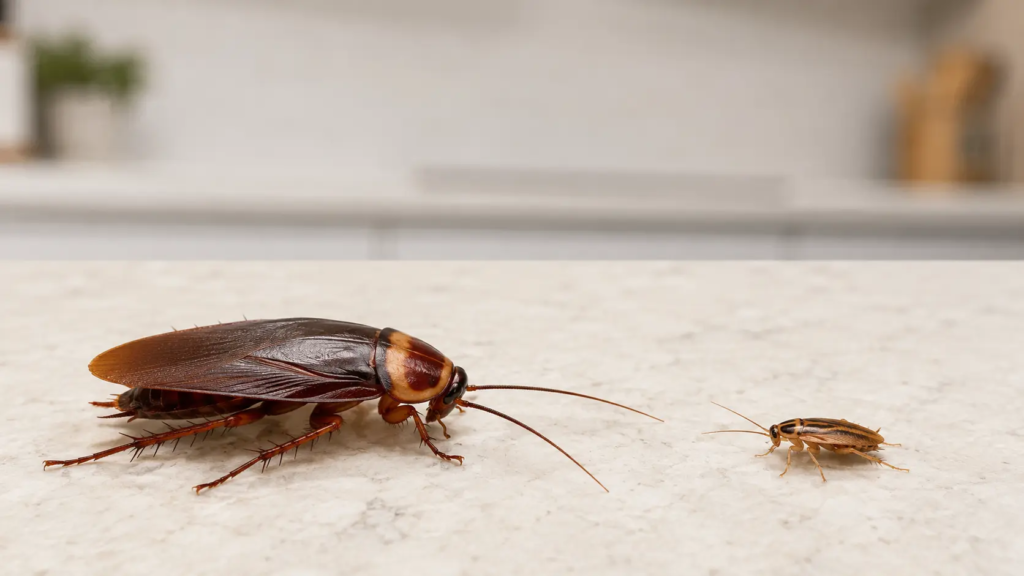
| QUICK ANSWER: PALMETTO BUG OR GERMAN COCKROACH? Both are cockroaches, but they mean very different things for your home. A palmetto bug (the Southern nickname for the American cockroach) is a large, reddish-brown roach that lives outdoors and wanders inside looking for moisture. A German cockroach is a small, tan roach with two dark stripes behind its head that lives and breeds indoors, usually in kitchens and bathrooms. Seeing a palmetto bug usually means a gap in your home’s defenses. Seeing a German cockroach usually means an infestation is already underway. |
Every roach sighting feels the same in the moment: something dark darts across the floor, and suddenly you are wide awake at 11 pm. But what you do next should depend entirely on which roach you just saw. One of them is an occasional trespasser. The other is a fast-multiplying houseguest that will not leave on its own.
Here is how to tell them apart in the few seconds before it disappears under the fridge.
The 30-Second Identification Checklist
| What to Look For | Palmetto Bug (American Cockroach) | German Cockroach |
| Size | Big. 1.5 to 2 inches long, one of the largest roaches you will see indoors | Small. About half an inch, rarely over 0.6 inches |
| Color | Reddish-brown to mahogany with a yellowish band behind the head | Light tan to brown with two dark parallel stripes behind the head |
| Flight | Has working wings and can fly or glide, especially on warm, humid nights | Has wings but cannot sustain flight; it runs instead |
| Where you see it | Crawl spaces, garages, bathrooms, near drains, coming in from mulch and leaf litter | Kitchens and bathrooms, near appliances, inside cabinets and wall voids |
| Time of activity | Night, often after rain or during hot, dry stretches | Night; daytime sightings suggest a heavy population |
| What it signals | An entry point and a moisture source | An established indoor breeding population |
What a Palmetto Bug Actually Is
Palmetto bug is a polite Southern nickname, not a separate species. Across Virginia, the Carolinas, Georgia, and Florida, it almost always refers to the American cockroach, though the smokybrown cockroach sometimes gets the same label. Both are large outdoor roaches that thrive in the warm, humid conditions our region provides in abundance.
Palmetto bugs live in mulch beds, palm boots, sewers, storm drains, and crawl spaces. They come indoors for two reasons: they followed moisture, or the weather pushed them in. Heavy rain floods their outdoor harborage and drives them inside. Long dry spells do the opposite, sending them in to look for water. Either way, your house was not the destination. It was just the nearest shelter with a gap big enough to squeeze through.
That is the good news about palmetto bugs. A sighting or two usually points to an exclusion problem (a torn door sweep, an unsealed pipe penetration, a gap under the garage door) rather than a colony living in your walls. Fix the entry points and the moisture, and the sightings mostly stop.
What a German Cockroach Sighting Means
German cockroaches are a different story, and the difference comes down to biology. They do not live outdoors in our region. If you see one in your kitchen, it was born in your kitchen, or very close to it.
They are also built for speed, reproductively speaking. A single female carries an egg case holding 30 to 40 eggs and produces several of them in her lifetime. Those offspring mature in as little as two months and start reproducing themselves. A few overlooked roaches behind the dishwasher can become hundreds in a single season, which is why German cockroach problems tend to feel like they appeared overnight.
Why German Roaches Are the Bigger Health Concern
- Allergens and asthma. Their droppings, shed skins, and body fragments are a well-documented asthma and allergy trigger, especially for children.
- Bacteria transfer. They travel between drains, garbage, and food-prep surfaces, picking up and depositing bacteria like Salmonella and E. coli along the way.
- Contamination range. Because they nest inside cabinets, appliances, and wall voids, they contaminate the exact places you store food and dishes.
Why Misidentifying Them Costs You
The treatment for each roach is almost the opposite of the other, which is why the ID matters more than it might seem.
Palmetto bug control happens mostly outside: sealing entry points, treating the perimeter, managing mulch and moisture, and addressing crawl spaces. Spraying inside your kitchen does very little, because the roaches are not living there.
German cockroach control happens almost entirely inside, and over-the-counter sprays often make it worse. Repellent sprays scatter roaches from their harborage into new hiding spots and can contaminate the gel baits that actually work. Effective German roach treatment relies on targeted baiting, insect growth regulators, and follow-up visits timed to their breeding cycle. It is one of the few household pests where the professional and DIY outcomes are genuinely far apart.
When to Call a Professional
- You are seeing small tan roaches in the kitchen or bathroom, even occasionally. German roaches multiply too fast to wait on.
- You see roaches during the daytime. That usually means the hiding spots are already crowded.
- Palmetto bug sightings continue after you have sealed obvious gaps and fixed moisture issues.
- You find droppings (pepper-like specks for German roaches) inside cabinets or drawers.
| Pests out, peace in. Not sure which roach you have? Send a photo or let us take a look. A Proforce inspection identifies the species, finds where they are coming from, and gets you a treatment plan built for your home, not a one-size-fits-all spray. Schedule Your Free Inspection Or call 800-546-4913 | proforcepest.com |