
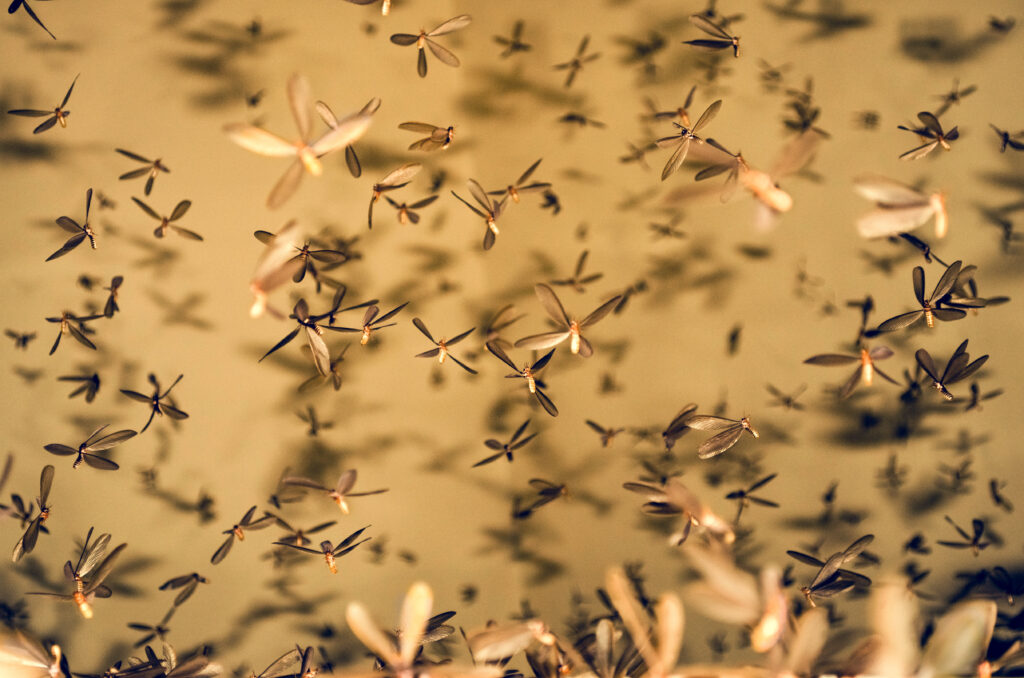
Termite swarming season in Florida peaks February through June across multiple species, signaling existing colonies and requiring annual inspections.
Key Takeaways
- Florida has multiple termite species, each with its own swarming window — some swarm as early as February, others as late as fall.
- Swarmers are winged reproductive termites that signal an existing colony nearby, not a new problem that just started.
- Discarded wings, mud tubes, and hollow-sounding wood are the three most reliable early warning signs.
- Florida’s subtropical climate keeps termites active throughout the year, making annual inspections critical for homeowners.
- Proforce uses the Trelona Advanced Termite Bait System and foundation trenching to protect Florida homes from subterranean termites.
When Termite Swarming Season Peaks in Florida
The Proforce Pest Almanac
Termite swarming in Florida, by the month.
Bar height shows when swarming activity peaks in a typical year. Swarm-peak months get a green edge.
Florida homeowners face termite swarms in nearly every month of the year, but the heaviest activity concentrates between February and June. The state’s subtropical climate, high humidity levels, and warm winters compress swarming windows and allow multiple species to overlap. No other state in the continental U.S. hosts the same density of destructive termite species active year-round.
Each species follows its own biological clock. Knowing which species swarms when gives you a meaningful head start on protecting your home before a colony establishes itself in your walls.
Spring and Early Summer Swarming Activity in Florida
Spring triggers the largest volume of termite swarming activity in Florida. Subterranean species respond to warm soil temperatures and rain events, sending winged reproductives out in large numbers. Research published in the Journal of Economic Entomology on flight phenology of Coptotermes species in southeastern Florida found that Asian subterranean termites (Coptotermes gestroi) fly from mid-February through late May, while Formosan subterranean termites (Coptotermes formosanus) swarm from early May through late June. These two invasive species represent some of the most structurally damaging termites in the state.
Eastern subterranean termites, the most widespread subterranean species in the southeastern United States, also swarm in spring and early summer. Their swarms tend to occur on warm days after rainfall, often in the morning hours. Finding piles of discarded wings near window sills or door frames on a spring morning is a reliable sign this species is active near your home.
Late-Season Swarms and Year-Round Termite Activity in Florida
Drywood termites tend to swarm later in the season than subterranean species. Their peak swarming activity runs through late summer and into early fall, typically July through September. Unlike subterranean termites, drywood termites live entirely within the wood they consume and do not require soil contact, which makes them harder to detect and control. Dampwood termites also swarm in late summer in areas with chronic moisture problems.
Florida’s year-round warmth means termite activity never fully stops between peak swarm seasons. Colonies continue feeding and growing through winter. According to UF/IFAS Entomology and Nematology, Florida’s climate supports a range of termite species not found elsewhere in the continental United States, and the state carries a disproportionate share of the nation’s termite damage burden.
Florida Termite Species and Their Swarming Patterns
Four primary species drive termite swarming activity in Florida, each with distinct biology, swarming windows, and damage profiles. Identifying which species you are dealing with changes both the urgency and the treatment approach.
Subterranean Termites in Florida: Eastern and Asian Species
Subterranean termites cause roughly 80% of all termite damage in the United States, according to a review of termite control evolution published in the journal Insects. In Florida, eastern subterranean termites are native and widespread. Asian subterranean termites are an invasive species concentrated in South Florida. Both species build colonies underground and travel to wood through mud tubes constructed along foundation walls, slabs, and other hard surfaces. A single mature colony can contain hundreds of thousands of workers.
Mud tubes are the clearest field sign for subterranean termites. These pencil-width tunnels of soil and debris run from the ground up foundation walls to reach wood above. Finding one should prompt an immediate inspection. Termite swarmers from these species are dark-bodied with long white wings that extend well past the abdomen.
Formosan Subterranean Termites in Florida: Invasive and Fast-Moving
Formosan subterranean termites represent a separate threat from native subterranean species. A peer-reviewed profile of Coptotermes formosanus confirms their invasive status and describes colony sizes that can reach several million workers, far larger than any native subterranean species. These termites build hardened carton nests within wall voids and attic spaces, allowing them to survive without continuous soil contact once established. They cause significant damage faster than any other subterranean species in Florida.
Formosan termite swarms occur in the evening and are strongly attracted to light fixtures, exterior lights, and porch lights. If you find large numbers of winged termites gathering around outdoor lights or entering through window screens on warm evenings between May and June, Formosan termites are the likely source.
Drywood Termites in Florida: No Soil, No Mud Tubes
Drywood termites need no soil contact and build smaller colonies than subterranean species. They enter homes through exposed wood, attic vents, and small gaps around roof lines, crawl spaces, and siding. Their swarming patterns in Florida peak from late summer through early fall. Unlike subterranean termites, drywood termites push frass, their dry pellet-like droppings, out of small holes in infested wood. Finding small holes or piles of termite droppings that resemble sawdust or sand on window sills and countertops is the most common early sign of drywood infestation.
Dampwood Termites in Florida: Moisture-Dependent Species
Dampwood termites target wood with high moisture content. They appear in Florida homes with chronic leaky pipes, plumbing leaks, or persistent roof moisture issues. They do not create mud tubes and rarely venture into dry structural wood. Proper ventilation, prompt plumbing repairs, and correcting drainage problems around the foundation both prevent and limit this species. Dampwood termite swarmers appear in late summer and are noticeably larger than subterranean swarmers.
Signs of Termite Infestation Florida Homeowners Should Know
Termite swarmers are often the first visible warning sign that a colony is already active near or inside your home. The swarm itself lasts only minutes to an hour. What remains afterward tells the real story. Discarded wings left in piles near windows, doors, and light fixtures indicate swarmers that found their way inside after emerging from a nearby colony.
Beyond swarmers, watch for these warning signs throughout the year:
- Mud tubes on foundation walls, interior walls, or plumbing penetrations signal subterranean termite activity.
- Hollow-sounding wood when tapped lightly on baseboards, door frames, or window trim indicates active feeding behind the surface.
- Termite droppings resembling fine sand or sawdust near wood surfaces point to drywood termite activity.
- Small holes in hardwood floors, baseboards, or trim are exit holes drywood termites create when swarming.
- Damage that looks like water damage on walls or ceilings with no plumbing leak nearby can indicate termite feeding within the wall cavity.
A termite infestation can be present for months before any visible structural damage appears. Annual inspections close that gap. Professional inspectors find evidence homeowners miss because termite damage develops out of sight inside walls, floor joists, and attic framing.
When to Call Pest Control for Termites in Florida
If you find a termite swarm inside your home, contact a pest control company the same day. A swarm indoors means the colony is either inside your home already or immediately adjacent to it. A swarm outdoors in your yard warrants an inspection within a few days. Waiting weeks after a swarm to schedule an inspection allows the colony time to expand and new reproductive pairs to begin establishing new colonies.
DIY termite treatments rarely address the full colony. As Proforce’s service documentation notes, products that are not applied in active areas at proper rates and shared through worker-to-worker contact fail to reach the majority of colony members hidden deep within wood and soil. The Proforce Trelona Advanced Termite Bait System uses the active ingredient Novaluron, which workers consume and carry back to the colony, affecting all castes through natural trophallaxis and grooming behavior. Termite colonies have been reduced in as few as 15 to 45 days with this system.
For established infestations, Proforce also offers foundation trenching, which creates a treated barrier around your home’s foundation. The active ingredient in liquid foundation treatments has a transfer effect that spreads through the colony on contact, similar to a biological relay. Each application provides protection for approximately five years.
Florida law requires new construction to receive a termite pre-treatment before the foundation is poured. Proforce performs these pre-treatments, including the blue-dye application that lets building inspectors confirm correct coverage. If you are adding to your home or remodeling, a pre-treatment protects the new structure before termites can access the fresh wood.
Protecting Your Florida Home from Termites Year-Round
Prevention reduces termite pressure significantly, but Florida’s climate means no home is entirely without risk. The steps below target the conditions that attract and sustain termite colonies near your foundation.
- Create a 12- to 18-inch crushed rock barrier between your foundation and any soil or mulch.
- Fix leaky pipes, leaky air conditioning drainage, and plumbing leaks that pool water near the foundation.
- Keep gutters clear so rainwater drains away from the structure rather than seeping into walls.
- Remove tree stumps, wood piles, and fallen debris from your yard. Dead wood near the foundation accelerates subterranean termite activity.
- Maintain proper ventilation in crawl spaces and attics to reduce humidity levels that support dampwood termite activity.
- Schedule professional termite inspections annually, not only when you see a swarm.
Ongoing protection through a bait station program removes the guesswork. Proforce installs Trelona stations approximately every 10 to 20 linear feet around the foundation perimeter. Service professionals monitor the stations annually and replace bait cartridges as needed. The bait remains effective for two to four years under typical conditions, providing ongoing protection between service visits.
Bottom Line on Termite Swarming Season in Florida
Florida’s termite swarming season stretches from February through fall, driven by a combination of subterranean, Formosan, drywood, and dampwood species that each follow their own schedule. The state’s subtropical climate means termite colonies remain active even outside peak swarm seasons. Swarmers are your first visible warning, but the colony behind them has often been feeding for months before you see a single winged termite.
Annual inspections, moisture control, and a professional bait station program are the most reliable tools for a Florida homeowner. If you spot a swarm, discarded wings, mud tubes, or hollow-sounding wood, schedule an inspection immediately. Proforce’s service professionals cover termite inspections and treatment across Florida with the Proforce Guarantee. Done Right. Every Time.
When is termite swarming season in Florida?
Florida termite swarming season runs nearly year-round. Asian subterranean termites swarm from mid-February through late May. Formosan subterranean termites swarm from early May through late June. Drywood termites swarm from late summer through early fall. Eastern subterranean termites swarm in spring after rain events. No single month is fully free of swarming activity in Florida.
What does a termite swarm look like?
Termite swarmers are winged reproductive termites roughly 3/8 of an inch long with two pairs of equal-length wings that extend past the abdomen. They are black or orange in color depending on species. Swarms often last only minutes and typically disperse quickly after emerging. The most common evidence you will find is piles of discarded wings near windows, door frames, and light fixtures.
Are termite swarmers dangerous to my home?
Swarmers themselves do not feed on wood and cause no direct structural damage. However, their presence confirms a mature, established colony is nearby. Each reproductive pair that survives after swarming can found a new colony. Finding swarmers inside your home is a strong signal that an active infestation already exists within or immediately adjacent to your structure.
How do I know if I have subterranean or drywood termites in Florida?
Subterranean termites leave mud tubes on foundation walls and hard surfaces. Drywood termites produce dry, pellet-like droppings and push them out through small holes in wood surfaces. Subterranean species require soil contact. Drywood species live entirely within the wood they infest and leave no mud tubes. A professional inspection is the most reliable way to confirm which species is active in your home.